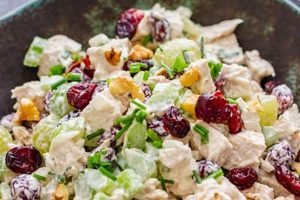
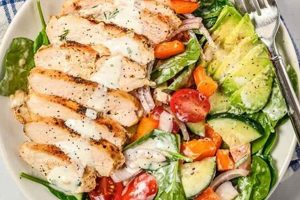
A deli-style chicken salad typically features diced chicken, mayonnaise, and a blend of seasonings. Variations often include celery, onion, grapes, or dried cranberries, offering a range of flavor profiles. These salads are readily available pre-made from delicatessens, providing a convenient meal or snack option.
Prepared chicken salads offer convenience for busy individuals seeking quick meal solutions or party platters. The quality of ingredients, particularly the chicken and mayonnaise, significantly impacts the overall taste and nutritional value. From classic recipes to innovative flavor combinations, these salads cater to diverse palates and have become a staple in many cultures.
The following sections explore preparing a similar salad at home, offering control over ingredient quality and customization options. Recipes will range from basic to gourmet, demonstrating diverse techniques and flavor pairings. Nutritional information and storage guidelines will also be provided.
Tips for Elevated Chicken Salad Preparation
Achieving a high-quality chicken salad involves careful consideration of ingredients and techniques. The following tips offer guidance for creating a superior culinary experience.
Tip 1: Chicken Selection: Opting for high-quality, cooked chicken breast ensures optimal flavor and texture. Rotisserie chicken offers a convenient shortcut, while poaching or grilling chicken breasts allows for greater control over seasoning.
Tip 2: Mayonnaise Matters: The mayonnaise base significantly influences the final product. Experimenting with different brands or creating homemade mayonnaise allows for customized flavor profiles. Consider incorporating additions like Dijon mustard or aioli for enhanced complexity.
Tip 3: Freshness is Key: Utilizing fresh produce elevates the salad’s flavor and texture. Thoroughly wash and crisp celery and onions before chopping. Incorporate freshly chopped herbs such as parsley, chives, or dill for a vibrant touch.
Tip 4: Balancing Flavors: Achieving a balanced flavor profile requires careful consideration of ingredients. Sweet elements, like grapes or dried cranberries, can complement savory components such as Dijon mustard or roasted red peppers. Taste and adjust seasonings throughout the preparation process.
Tip 5: Texture Considerations: The desired texture influences ingredient preparation. Finely dicing ingredients creates a smoother consistency, while coarser chopping yields a chunkier salad. Consider incorporating nuts or seeds for added textural complexity.
Tip 6: Proper Chilling: Chilling the prepared salad for at least 30 minutes allows the flavors to meld and enhances the overall experience. Ensure proper storage in airtight containers to maintain freshness.
Tip 7: Creative Serving Suggestions: Explore various serving options beyond traditional bread. Consider serving the salad on croissants, crackers, lettuce wraps, or as a filling for sandwiches.
By employing these strategies, one can create a chicken salad that is both flavorful and satisfying. Attention to detail and quality ingredients contribute to a truly exceptional culinary outcome.
The following section provides a concluding overview of the key elements discussed and offers suggestions for further exploration.
1. High-quality Chicken

High-quality chicken plays a crucial role in a Boar’s Head-style chicken salad, significantly impacting the overall flavor, texture, and nutritional value. The type of chicken used influences the final product’s moistness, tenderness, and ability to absorb flavors. Chicken breast, known for its lean protein and delicate flavor, is typically preferred. Using free-range or organic chicken, while not a requirement for replicating the Boar’s Head style, can further enhance the flavor and align with consumer preferences for ethically sourced ingredients. Conversely, using lower-quality chicken with added fillers or excessive moisture can result in a less desirable, watery salad.
The cooking method also affects the chicken’s suitability for salad. Overcooked chicken becomes dry and stringy, detracting from the salad’s texture. Ideally, the chicken should be cooked until just done, retaining moisture and tenderness. Methods like poaching or roasting allow for precise temperature control and flavor infusion. Alternatively, using pre-cooked rotisserie chicken provides a convenient option, but careful selection is crucial. Rotisserie chickens can sometimes be over-salted or dry, potentially affecting the final salad’s quality.
Ultimately, prioritizing high-quality chicken establishes a strong foundation for a successful Boar’s Head-style chicken salad. The choice of chicken and its preparation directly correlate with the final product’s overall quality. Attention to this detail ensures a flavorful, satisfying, and texturally pleasing salad that mirrors the deli-counter experience.
2. Proper Mayonnaise Selection

Mayonnaise serves as the foundational binding agent in a Boar’s Head-style chicken salad, significantly influencing the final product’s flavor, texture, and overall quality. The choice of mayonnaise directly impacts the salad’s creaminess, tanginess, and richness. Boar’s Head likely employs a specific mayonnaise formulation to achieve its signature taste; replicating this requires careful consideration of commercially available options. Factors such as the type of oil used (soybean, canola, or olive), the presence of egg yolks, and the balance of acidity (vinegar or lemon juice) all contribute to the mayonnaise’s unique characteristics. A mayonnaise with a higher oil content contributes to a richer, creamier texture, while a higher acidity level provides a tangier flavor profile.
Using a lower-quality mayonnaise, characterized by excessive sweetness, artificial flavors, or a thin consistency, can negatively impact the chicken salad. Such mayonnaises can mask the delicate flavors of the chicken and other ingredients, resulting in an unbalanced and less satisfying final product. For example, a mayonnaise with a strong sweetness profile can clash with the savory notes of the chicken and seasonings. Similarly, a thin, watery mayonnaise compromises the salad’s texture, leading to a less desirable, runny consistency. Opting for a mayonnaise similar to Boar’s Head’s, likely one with a balanced flavor profile, creamy texture, and minimal additives, provides a closer approximation to the desired outcome.
Selecting the appropriate mayonnaise is crucial for replicating a Boar’s Head-style chicken salad. The interplay between the mayonnaise and other ingredients directly influences the final product’s taste and texture. Careful consideration of the mayonnaise’s composition, flavor profile, and consistency ensures a harmonious blend of flavors and textures, resulting in a chicken salad that accurately reflects the desired deli-quality experience.
3. Precisely Diced Ingredients

Uniformly diced ingredients contribute significantly to the distinctive texture and flavor profile often associated with a Boar’s Head-style chicken salad. Precision in dicing ensures even distribution of ingredients throughout the salad, preventing pockets of individual components and promoting a harmonious blend of flavors. This consistent size also enhances the salad’s aesthetic appeal, contributing to a visually appealing final product. Consider the difference between a salad with unevenly chopped celery, where some pieces are large and crunchy while others are nearly minced, and a salad with uniformly diced celery, offering a consistent textural experience in each bite. The former presents a disjointed texture, while the latter provides a balanced and predictable mouthfeel.
Precise dicing further facilitates consistent flavor release. Uniformly sized pieces of ingredients, such as celery, onions, and herbs, offer consistent surface area exposure to the mayonnaise and seasonings, promoting even flavor distribution. This uniformity ensures that each bite delivers a balanced blend of flavors, rather than isolated bursts of individual components. For instance, finely diced red onion disperses its pungent flavor more evenly throughout the salad compared to larger, unevenly chopped pieces, which can deliver overwhelming bursts of onion flavor in some bites and be absent in others. This principle extends to other ingredients, including the chicken itself, where consistent sizing ensures uniform flavor absorption and distribution.
Achieving a Boar’s Head-style chicken salad hinges on attention to detail, including the precise dicing of ingredients. This practice not only contributes to a visually appealing product but also ensures a consistent and balanced flavor experience. The uniformity achieved through precise dicing promotes even distribution of ingredients, maximizes surface area contact with seasonings and mayonnaise, and ultimately elevates the overall quality and enjoyment of the chicken salad.
4. Balanced Seasoning Blend
A balanced seasoning blend distinguishes a standard chicken salad from a premium, Boar’s Head-inspired creation. This balance hinges on the careful interplay of salt, pepper, and other complementary spices. While salt enhances the inherent flavors of the chicken and other ingredients, pepper provides a subtle heat and complexity. Over-reliance on either element disrupts the balance, resulting in a salad that is either bland or overly peppery. The addition of other spices, such as paprika, garlic powder, or onion powder, further contributes to depth and complexity. However, the key lies in restraint. Over-seasoning can mask the delicate flavors of the chicken and other fresh ingredients. Boar’s Head’s likely success stems from achieving a precise balance that accentuates the chicken’s flavor without overpowering it.
Consider a scenario where a chicken salad relies solely on salt for seasoning. The result is a one-dimensional flavor profile that lacks depth and complexity. Conversely, excessive black pepper can create an unpleasant burning sensation that overshadows the other ingredients. A well-balanced blend, however, might incorporate a measured amount of salt, a touch of black pepper, a hint of paprika for smokiness, and a dash of garlic powder for savory depth. This nuanced approach creates a symphony of flavors that complement and enhance the chicken and other ingredients, rather than masking them. This exemplifies the crucial role of a balanced seasoning blend in achieving a high-quality chicken salad.
Mastering this delicate balance allows for a chicken salad that showcases the quality of its ingredients. The ultimate goal is to create a flavor profile that is both complex and harmonious. Challenges arise when attempting to replicate a specific brand’s flavor profile, as precise spice ratios are often proprietary. However, understanding the principles of balance provides a solid foundation for experimentation and customization, allowing individuals to craft their own signature chicken salad recipes. This knowledge translates into a practical application of culinary expertise, transforming a simple chicken salad into a culinary delight.
5. Freshness of Ingredients
Ingredient freshness significantly impacts the overall quality of a Boar’s Head-style chicken salad. Fresh ingredients contribute to superior flavor, optimal texture, and enhanced food safety. Consider the stark contrast between a salad made with freshly roasted chicken versus one using chicken several days past its prime. The fresh chicken offers a clean, vibrant flavor, while the older chicken may impart off-flavors, impacting the entire salad’s palatability. Similarly, fresh celery and onions provide a crisp, satisfying crunch, whereas older produce can become soft, wilted, and less flavorful. Fresh herbs, like parsley or dill, offer bright, aromatic notes that elevate the salad, while dried or wilted herbs lack the same vibrancy. The mayonnaise, too, benefits from freshness, offering a clean, creamy texture and flavor that complements the other ingredients. Using fresh, high-quality mayonnaise avoids the potential for off-flavors or a compromised texture that can detract from the overall experience.
The impact of ingredient freshness extends beyond flavor and texture to food safety. Using fresh ingredients minimizes the risk of bacterial contamination, a critical concern with perishable items like chicken and mayonnaise. Freshly prepared chicken salad, stored properly, poses a significantly lower risk of foodborne illness compared to a salad made with older ingredients. This emphasis on freshness aligns with consumer expectations for safe, high-quality food products, a cornerstone of the Boar’s Head brand reputation. Furthermore, the perceived freshness of a chicken salad directly influences consumer perception of its overall quality. A salad made with vibrant, crisp ingredients suggests careful preparation and attention to detail, enhancing the perceived value and enjoyment of the product.
Prioritizing fresh ingredients is paramount in replicating a Boar’s Head-style chicken salad. The enhanced flavor, optimal texture, and improved food safety associated with fresh ingredients contribute significantly to the overall quality and enjoyment of the final product. This understanding allows for informed ingredient selection and preparation, resulting in a chicken salad that reflects the high standards associated with the Boar’s Head brand. Recognizing the crucial role of freshness provides a practical framework for achieving a superior culinary outcome, emphasizing the connection between ingredient quality and the final product’s excellence.
6. Appropriate Chilling Time
Appropriate chilling time plays a crucial role in the development of flavor and texture in a Boar’s Head-style chicken salad. Chilling allows the flavors of the various ingredientschicken, mayonnaise, celery, onion, and seasoningsto meld and harmonize. This melding process enhances the overall complexity and balance of the final product. The cool temperature also firms the texture of the chicken and other ingredients, contributing to the desired consistency. A freshly made salad, while palatable, often lacks the depth of flavor achieved through chilling. The individual ingredients’ flavors remain distinct, rather than integrating into a cohesive whole. The texture may also be less desirable, with the ingredients feeling somewhat loose and less cohesive. For instance, allowing the salad to chill for at least two hours in a refrigerator set at a safe temperature of 40F (4C) or below allows the flavors to fully develop and the textures to firm, creating a more refined and enjoyable culinary experience.
Beyond flavor and texture enhancement, appropriate chilling time contributes significantly to food safety. Chicken salad, containing perishable ingredients like chicken and mayonnaise, is susceptible to bacterial growth at room temperature. Chilling inhibits bacterial proliferation, reducing the risk of foodborne illness. Food safety guidelines recommend maintaining cold foods at or below 40F (4C) to minimize bacterial growth. This highlights the practical significance of appropriate chilling time not only for enhancing sensory qualities but also for ensuring consumer safety. Insufficient chilling time can create an environment conducive to bacterial growth, potentially leading to health risks. Conversely, adhering to recommended chilling times safeguards consumer well-being while simultaneously enhancing the salad’s flavor and texture.
Chilling is an essential step, inextricably linked to both the sensory experience and food safety aspects of a Boar’s Head-style chicken salad. The benefits of chilling extend beyond mere cooling; it acts as a catalyst for flavor development, texture enhancement, and food safety assurance. Understanding the importance of appropriate chilling time provides a foundation for producing a chicken salad that is not only delicious but also safe to consume. This knowledge allows for informed decision-making regarding preparation and storage, ultimately contributing to a superior and safer culinary outcome. Failure to appreciate the significance of chilling can compromise both the quality and safety of the final product, underscoring the crucial role this step plays in achieving the desired result.
7. Creative Serving Suggestions
Creative serving suggestions elevate the versatility and appeal of a Boar’s Head-style chicken salad, transforming it from a simple staple into a culinary centerpiece. While the quality of the salad itself remains paramount, innovative presentation enhances the dining experience, showcasing the salad’s potential beyond traditional applications. Consider the impact of serving the chicken salad atop crisp lettuce cups rather than simply on bread. This seemingly minor change introduces a textural contrast and a lighter, fresher element, broadening the salad’s appeal to those seeking healthier options. Similarly, incorporating the salad into a croissant or a flaky pastry elevates it into a more sophisticated offering, suitable for brunches or special occasions. These variations demonstrate the transformative power of creative presentation, turning a familiar dish into a more dynamic and versatile culinary creation. Offering a variety of serving options also caters to diverse dietary preferences and expands the occasions for which the salad is appropriate, thereby increasing its overall utility and appeal.
Practical examples further illustrate the significance of creative serving suggestions. Imagine a catered event where the chicken salad is not only offered as a sandwich filling but also as a dip served with assorted crackers and crudits. This approach caters to different tastes and provides a visually appealing spread. In a home setting, transforming the chicken salad into a filling for bell peppers or tomatoes offers a refreshing alternative, particularly during warmer months. These examples demonstrate the practical application of creative serving suggestions, enhancing the perceived value and enjoyment of the chicken salad. Furthermore, innovative presentation can stimulate interest and encourage consumption, particularly among those who may perceive chicken salad as a predictable or mundane dish. The visual appeal of a creatively presented salad can entice diners to try it, even if they wouldn’t typically choose a traditional chicken salad sandwich. This factor contributes significantly to the success of food service establishments and catering businesses, demonstrating the tangible benefits of creative presentation in driving customer satisfaction and repeat business.
Ultimately, creative serving suggestions represent a key element in maximizing the culinary potential of a Boar’s Head-style chicken salad. While the recipe’s quality provides the foundation, innovative presentation elevates the dining experience, expands the salad’s versatility, and broadens its appeal. This understanding provides a framework for transforming a simple chicken salad into a dynamic culinary offering, suitable for a variety of occasions and palates. Successfully implementing this principle involves considering the target audience, the context of the meal, and the desired overall dining experience. By strategically applying creative serving suggestions, one can elevate a classic dish into a culinary highlight, showcasing its full potential and exceeding expectations.
Frequently Asked Questions
This section addresses common inquiries regarding the preparation and characteristics of deli-style chicken salad, often associated with Boar’s Head products, offering practical guidance and clarification.
Question 1: What distinguishes a high-quality, deli-style chicken salad?
Premium ingredients, including cooked chicken breast, high-quality mayonnaise, and fresh produce, form the foundation. Precise dicing of ingredients contributes to a consistent texture, while a balanced seasoning blend enhances the overall flavor profile. Proper chilling allows flavors to meld, resulting in a more cohesive and satisfying culinary experience.
Question 2: Can one replicate a specific brand’s, such as Boar’s Head’s, chicken salad recipe precisely?
Replicating a specific brand’s proprietary recipe exactly can be challenging due to undisclosed ingredient ratios and preparation techniques. However, focusing on high-quality ingredients and precise techniques allows for a close approximation of the desired flavor profile and texture.
Question 3: What factors influence the overall texture of chicken salad?
The size of the diced ingredients plays a significant role. Finely diced components create a smoother, more homogenous texture, while coarser chopping yields a chunkier salad. The type and quantity of mayonnaise also impact the final product’s creaminess and consistency.
Question 4: How does the choice of mayonnaise affect the final product?
Mayonnaise serves as the binding agent and significantly influences flavor and texture. A high-quality mayonnaise, preferably one with a balanced flavor profile and creamy texture, enhances the overall quality of the chicken salad. Lower-quality mayonnaise can introduce undesirable flavors or compromise the salad’s consistency.
Question 5: What safety precautions should one consider when preparing chicken salad?
Thorough handwashing, proper sanitation of utensils and surfaces, and maintaining appropriate chilling temperatures are crucial for preventing bacterial contamination. Using fresh, high-quality ingredients further minimizes food safety risks. Adhering to recommended food safety guidelines ensures a safe and enjoyable culinary experience.
Question 6: How can one elevate chicken salad beyond a traditional sandwich filling?
Creative serving suggestions broaden the culinary applications of chicken salad. Consider using it as a filling for lettuce wraps, croissants, or vegetables. Presenting it as a dip with crackers and crudits offers another appealing option. Such variations enhance versatility and cater to diverse dining preferences.
Understanding these fundamental aspects of preparation and ingredient selection ensures a superior chicken salad experience. Attention to detail, from ingredient quality to chilling time, contributes significantly to the final product’s overall quality, safety, and enjoyment.
The following section will provide a selection of recipes demonstrating these principles in practical application.
Boar’s Head Chicken Salad Recipe
This exploration of deli-style chicken salad, often associated with Boar’s Head products, has highlighted the critical components contributing to its distinctive qualities. From the selection of premium ingredientsfreshly cooked chicken, high-quality mayonnaise, and crisp produceto the precision in dicing and the careful balancing of seasonings, each step plays a crucial role in the final product. Proper chilling allows the flavors to meld, resulting in a harmonious blend, while creative serving suggestions elevate the dining experience beyond the traditional sandwich. Food safety considerations, including proper handling and temperature control, underscore the commitment to quality and consumer well-being.
Ultimately, understanding these key elements empowers culinary enthusiasts to create exceptional chicken salads, approaching the quality and flavor profiles often associated with established brands. This knowledge translates into an enhanced appreciation for the craftsmanship involved in creating seemingly simple dishes and encourages a more discerning approach to ingredient selection and preparation techniques. The pursuit of culinary excellence extends beyond mere replication; it fosters innovation and personalization, allowing individuals to create signature dishes that reflect their own unique tastes and preferences.