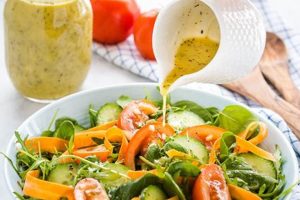
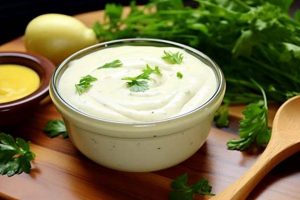
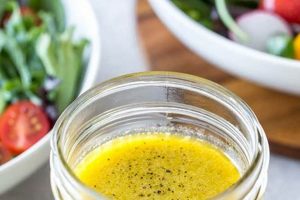
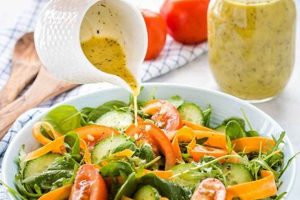
High-quality Italian salad dressings typically blend olive oil, vinegar (often red wine or balsamic), and a variety of herbs and spices such as oregano, basil, garlic, and red pepper flakes. A well-executed dressing emulsifies these ingredients, creating a harmonious balance of tartness, richness, and herbaceous flavors that enhance the salad’s ingredients rather than masking them. For instance, a classic vinaigrette might combine extra virgin olive oil, red wine vinegar, minced garlic, dried oregano, salt, and pepper.
The pursuit of exceptional dressings elevates a simple salad from a side dish to a culinary experience. A superior dressing provides not only flavor but also texture and visual appeal. Historically, Italian cuisine has emphasized fresh, high-quality ingredients and simple preparations that allow those ingredients to shine. Thus, the dressing plays a vital role in complementing and unifying the flavors of the salad components. The right dressing can transform basic lettuce, tomatoes, and cucumbers into a vibrant and satisfying dish.
This exploration will delve into the nuances of crafting exemplary Italian-style dressings, examining variations in ingredients, techniques, and pairings with different salad compositions. From classic vinaigrettes to creamy variations, the goal is to unlock the secrets to creating dressings that enhance the dining experience.
Tips for Exceptional Italian Salad Dressings
Creating a memorable Italian salad dressing involves attention to detail and a balance of flavors. The following tips offer guidance on achieving optimal results.
Tip 1: Use High-Quality Olive Oil: The foundation of any great Italian dressing is extra virgin olive oil. Its rich flavor and smooth texture contribute significantly to the overall quality. Opt for a robust, flavorful oil.
Tip 2: Freshly Squeezed is Best: Bottled lemon or lime juice often contains preservatives that can detract from the fresh, vibrant flavors of a good dressing. Freshly squeezed juice provides a brighter, more natural taste.
Tip 3: Balance Acidity: The right balance of acidity is crucial. While vinegar provides the necessary tang, excessive acidity can overpower the other flavors. Taste and adjust accordingly, potentially adding a touch of sweetness to balance the tartness.
Tip 4: Emulsify Thoroughly: Proper emulsification creates a smooth, creamy texture that coats the salad ingredients evenly. Whisk the oil and vinegar vigorously or use a blender to achieve a stable emulsion.
Tip 5: Seasoning is Key: Freshly ground black pepper and high-quality sea salt enhance the other flavors in the dressing. Start with a small amount and adjust to taste, remembering that the flavors will meld over time.
Tip 6: Fresh Herbs Elevate: Fresh herbs such as oregano, basil, and thyme add depth and complexity. Chop them finely to release their aroma and flavor. Dried herbs can be substituted but use them sparingly as their flavor is more concentrated.
Tip 7: Garlic with Caution: Garlic adds a pungent kick, but too much can dominate the dressing. Use it judiciously, mincing it finely or using a garlic press to distribute the flavor evenly.
By following these tips, one can create dressings that not only complement the salad ingredients but also stand on their own as a testament to the art of Italian cuisine.
These foundational principles provide a framework for experimentation and customization. The following section will explore specific recipe variations.
1. High-quality olive oil

High-quality olive oil forms the foundation of exceptional Italian salad dressings. Its contribution extends beyond mere fattiness; it imparts distinct flavor profiles and textural nuances crucial for achieving a balanced and flavorful dressing. Understanding the characteristics of high-quality olive oil is essential for crafting dressings that elevate the culinary experience.
- Extra Virgin Classification:
The “extra virgin” designation signifies that the oil has been extracted solely through mechanical means, without the use of heat or chemicals. This process preserves the oil’s natural flavors and antioxidants. Extra virgin olive oils possess a lower acidity level (less than 0.8%), contributing to a smoother, less bitter taste crucial for balancing the other ingredients in the dressing.
- Flavor Profiles:
Olive oil exhibits a diverse range of flavor profiles, from peppery and robust to fruity and delicate. These variations stem from the olive varietal, terroir, and harvesting methods. Selecting an olive oil with a complementary flavor profile is essential. For example, a robust, peppery oil might pair well with a simple vinaigrette, while a milder, fruitier oil might complement a dressing with citrus notes.
- Impact on Emulsification:
The quality of olive oil directly impacts the stability and texture of the emulsion in the dressing. High-quality extra virgin olive oil possesses a chemical composition that promotes a more stable emulsion, preventing the oil and vinegar from separating quickly. This stability ensures the dressing coats the salad ingredients evenly, delivering a consistent flavor experience.
- Health Benefits:
Beyond flavor and texture, high-quality olive oil contributes to the nutritional value of the salad. Extra virgin olive oil is rich in monounsaturated fats and antioxidants, which offer various health benefits. Incorporating such an oil elevates the nutritional profile of the entire dish, aligning with the Italian culinary emphasis on fresh, wholesome ingredients.
The selection of high-quality olive oil is not merely a preliminary step but an integral component of crafting the best Italian salad dressings. Its flavor profile, impact on emulsification, and health benefits contribute significantly to the overall quality and enjoyment of the dish. Appreciating the nuances of olive oil allows for informed choices that enhance the culinary experience.
2. Fresh Herbs
Fresh herbs constitute a cornerstone of exceptional Italian salad dressings, contributing significantly to their aromatic complexity and vibrant flavor profiles. Their inclusion elevates a simple vinaigrette to a culinary creation, reflecting the Italian culinary tradition’s emphasis on fresh, high-quality ingredients. Examining the role of fresh herbs illuminates their importance in achieving optimal dressing quality.
- Aromatic Depth and Complexity
Fresh herbs offer a wide spectrum of aromatic notes that add depth and complexity to Italian salad dressings. Unlike dried herbs, fresh herbs retain volatile oils that contribute to a brighter, more nuanced flavor. For example, basil provides a sweet, slightly peppery aroma, while oregano offers a pungent, earthy note. These distinct aromas intermingle with the other dressing components, creating a more sophisticated and layered flavor profile.
- Visual Appeal and Freshness
Beyond flavor, fresh herbs enhance the visual appeal of the salad and the dressing itself. Incorporating vibrant green basil leaves, deep green oregano sprigs, or feathery fronds of dill adds a touch of freshness and elegance to the dish. The visual element enhances the overall dining experience, signaling the use of high-quality, seasonal ingredients.
- Synergistic Flavor Combinations
Fresh herbs often work synergistically with other common ingredients in Italian salad dressings, such as garlic, lemon juice, and olive oil. For example, the peppery notes of oregano complement the pungent bite of garlic, while basil’s sweetness balances the acidity of lemon juice. These synergistic combinations create a harmonious balance of flavors that elevates the overall taste of the dressing.
- Versatility and Customization
The versatility of fresh herbs allows for extensive customization of Italian salad dressings. A simple vinaigrette can be transformed by the addition of different herbs, catering to individual preferences and complementing specific salad ingredients. For instance, a salad featuring tomatoes and mozzarella might benefit from the addition of fresh basil, while a salad with roasted vegetables might pair well with rosemary or thyme. This adaptability allows for endless creative possibilities.
The inclusion of fresh herbs in Italian salad dressings transcends mere flavor enhancement. It represents a commitment to quality ingredients and culinary artistry. The aromatic complexity, visual appeal, synergistic flavor combinations, and inherent versatility of fresh herbs contribute significantly to creating dressings that elevate the entire dining experience, reflecting the essence of Italian culinary tradition.
3. Balanced Acidity
Balanced acidity represents a critical factor in crafting exceptional Italian salad dressings. The interplay between acidity and other flavor components determines the overall balance and palatability of the dressing. A well-balanced dressing complements, rather than overwhelms, the flavors of the salad ingredients. Understanding the nuances of acidity is essential for achieving optimal results.
- The Role of Vinegar
Vinegar serves as the primary source of acidity in most Italian salad dressings. The type of vinegar employed significantly influences the final flavor profile. Red wine vinegar contributes a robust, slightly fruity tartness, while white wine vinegar offers a lighter, more delicate acidity. Balsamic vinegar, with its complex sweetness and tang, adds a unique dimension. The choice of vinegar should complement the other ingredients in the dressing and the salad itself.
- Counterbalancing Acidity with Sweetness
A touch of sweetness often balances the sharpness of vinegar. This can be achieved through the addition of a small amount of sugar, honey, or even a pinch of balsamic glaze. This counterbalance creates a more rounded flavor profile, preventing the acidity from becoming overpowering. The level of sweetness should be carefully calibrated to avoid creating an overly sweet dressing.
- Acidity as a Flavor Enhancer
Acidity not only contributes to the overall taste but also functions as a flavor enhancer. It brightens the other flavors in the dressing, making them more pronounced and vibrant. For instance, the acidity of vinegar can enhance the herbaceous notes of fresh herbs or the savory flavors of garlic and onion. This synergistic effect is crucial for creating a dynamic and complex flavor profile.
- Impact on Emulsification
Acidity plays a role in the emulsification process of the dressing. The presence of vinegar helps to stabilize the emulsion, preventing the oil and vinegar from separating too quickly. This stability ensures the dressing coats the salad ingredients evenly, providing a consistent flavor experience. A balanced level of acidity contributes to a smoother, more homogenous emulsion.
Achieving balanced acidity requires careful consideration of the interplay between vinegar, sweetness, and the other flavor components. This balance is essential for creating dressings that enhance the overall dining experience, demonstrating a nuanced understanding of Italian culinary principles. The right balance elevates a simple salad to a sophisticated culinary creation, showcasing the harmony of flavors achievable through a well-crafted Italian dressing.
4. Proper Emulsification

Proper emulsification represents a crucial step in creating superior Italian salad dressings. Emulsification refers to the process of combining two immiscible liquids, such as oil and vinegar, into a stable mixture. In the context of Italian dressings, proper emulsification creates a homogenous, creamy texture that evenly coats salad ingredients, ensuring a consistent flavor experience in every bite. A poorly emulsified dressing separates quickly, resulting in an oily, unbalanced final product. The stability of the emulsion impacts not only the texture but also the perceived flavor, as a separated dressing delivers uneven bursts of oil and vinegar rather than a harmonious blend.
Several factors influence emulsification. Vigorous whisking or the use of a blender provides the mechanical energy required to disperse the vinegar droplets within the oil, creating a temporary emulsion. Ingredients such as mustard or honey act as emulsifiers, containing molecules with both hydrophilic (water-loving) and hydrophobic (oil-loving) ends. These molecules position themselves at the interface between the oil and vinegar, reducing surface tension and promoting a more stable emulsion. The quality of the olive oil also plays a role; extra virgin olive oil, with its specific chemical composition, generally emulsifies more readily than lower-quality oils. A classic vinaigrette, when properly emulsified, showcases the creamy texture achievable through this process, clinging evenly to the salad components and delivering a balanced blend of oil, vinegar, and seasonings.
Understanding the principles of emulsification enables the creation of dressings that not only taste exceptional but also exhibit a desirable texture. This knowledge translates to practical kitchen skills, allowing for adjustments based on ingredient variations and desired outcomes. The success of many classic Italian dressings hinges on a properly executed emulsion, demonstrating its significance as a fundamental element of high-quality culinary creations. Mastering this technique contributes to the creation of dressings that truly elevate the dining experience.
5. Seasoning
Seasoning represents the crucial final step in crafting exceptional Italian salad dressings, elevating them from simple mixtures to complex flavor experiences. It is in this stage that the careful balance of ingredients achieves its full potential, transforming individual components into a harmonious whole. The judicious use of seasonings distinguishes a truly exceptional dressing, demonstrating a nuanced understanding of flavor dynamics.
- Salt: The Foundation of Flavor
Salt serves as the cornerstone of seasoning, enhancing the inherent flavors of the other ingredients. It not only adds saltiness but also amplifies sweetness and mitigates bitterness, creating a more balanced flavor profile. The type of salt employed can further nuance the taste. Sea salt, with its mineral complexity, adds depth, while kosher salt offers a clean, consistent salinity. In the context of Italian dressings, salt acts as the crucial binding element, harmonizing the flavors of oil, vinegar, and herbs. A pinch of salt in a classic vinaigrette, for example, brings the disparate elements into focus, allowing the individual flavors to shine while contributing to the overall taste experience.
- Black Pepper: A Touch of Pungency
Freshly ground black pepper introduces a layer of complexity to Italian dressings, providing a subtle heat and a slightly pungent aroma. Its sharp bite contrasts with the richness of the olive oil and the acidity of the vinegar, adding a dynamic element to the flavor profile. The freshly ground format is crucial, as pre-ground pepper loses its volatile oils over time, diminishing its aromatic impact. In a lemon-herb dressing, for instance, black pepper’s pungency balances the brightness of the citrus and the herbaceous notes, creating a more intricate and engaging flavor experience.
- Beyond the Basics: Exploring Additional Seasonings
While salt and pepper form the core of seasoning, exploring other options can further personalize and enhance Italian salad dressings. A pinch of red pepper flakes adds a touch of heat, while a small amount of garlic powder or onion powder contributes savory depth. A dash of dried herbs, used sparingly, can complement fresh herbs or introduce subtle background notes. The key is to use these additional seasonings judiciously, avoiding overpowering the core flavors of the dressing. For example, a balsamic vinaigrette might benefit from a hint of dried oregano to deepen its herbaceous character, while a creamy dressing might be enhanced by a touch of garlic powder for added savory complexity.
- Tasting and Adjusting: The Final Touch
The process of seasoning an Italian salad dressing is not a formulaic exercise but an iterative one. Tasting and adjusting throughout the process is essential for achieving optimal results. Initial seasoning establishes a baseline, but the flavors evolve as the ingredients meld. A final tasting allows for fine-tuning, ensuring that the salt, pepper, and any additional seasonings are in perfect harmony. This attention to detail, this commitment to nuanced flavor development, distinguishes a truly exceptional dressing from a merely adequate one.
Seasoning, therefore, is not simply an afterthought but an integral part of crafting the best Italian salad dressings. It is the crucial final step that brings all the elements together, transforming individual ingredients into a cohesive and flavorful whole. The careful balance of salt, pepper, and other seasonings elevates the dressing, enhancing the overall dining experience and reflecting a true understanding of Italian culinary principles.
Frequently Asked Questions
This section addresses common inquiries regarding the creation of high-quality Italian salad dressings, offering practical guidance and clarifying potential misconceptions.
Question 1: What distinguishes “extra virgin” olive oil, and why is it preferred for Italian dressings?
Extra virgin signifies the highest quality olive oil, extracted solely through mechanical means without heat or chemicals, preserving its natural flavors and antioxidants. Its low acidity and robust flavor profile make it ideal for dressings.
Question 2: Can dried herbs be substituted for fresh herbs in Italian dressings?
While dried herbs can be used, fresh herbs provide a brighter, more nuanced flavor. If substituting, use dried herbs sparingly, as their flavor is more concentrated.
Question 3: How can one prevent an Italian dressing from separating?
Proper emulsification is key. Vigorous whisking or blending helps create a stable emulsion. Adding a small amount of mustard or honey can also act as an emulsifier, binding the oil and vinegar together.
Question 4: What type of vinegar is best suited for Italian dressings?
Red wine vinegar, white wine vinegar, and balsamic vinegar are commonly used. The best choice depends on the desired flavor profile and the other ingredients in the dressing. Red wine vinegar offers a robust tartness, white wine vinegar is milder, and balsamic vinegar provides a sweet and tangy complexity.
Question 5: How can one balance the acidity in an Italian dressing?
A touch of sweetness, such as sugar, honey, or balsamic glaze, can balance the acidity of the vinegar. Taste and adjust carefully to achieve the desired balance.
Question 6: How long can homemade Italian dressing be stored?
Homemade Italian dressing can typically be stored in an airtight container in the refrigerator for up to one week. Fresh herbs may wilt slightly over time, but the flavor will generally remain intact.
Understanding these key aspects of creating Italian salad dressings empowers one to craft flavorful and balanced dressings that elevate any salad. Attention to detail and quality ingredients yield superior results, reflecting the essence of Italian culinary tradition.
The next section will delve into specific recipe variations, demonstrating the practical application of these principles.
Crafting Exceptional Italian Salad Dressings
The pursuit of exemplary Italian salad dressings involves a nuanced understanding of key elements: high-quality olive oil as a foundation, the aromatic complexity of fresh herbs, the crucial balance of acidity, the importance of proper emulsification, and the transformative power of seasoning. These elements work synergistically, elevating simple ingredients into a harmonious whole. From classic vinaigrettes to more complex variations, attention to detail and a commitment to quality ingredients distinguish truly exceptional dressings.
The exploration of these components underscores the potential for culinary artistry within the seemingly simple act of creating a salad dressing. Mastery of these principles allows for customization and adaptation, empowering individuals to create dressings that not only complement their salads but also stand as testaments to the rich tradition of Italian cuisine. The journey towards crafting the perfect Italian salad dressing is an ongoing exploration of flavor, texture, and balancea pursuit that elevates the everyday salad into a culinary experience.