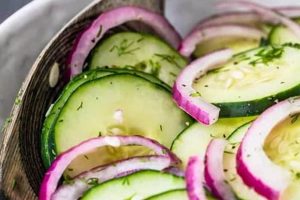
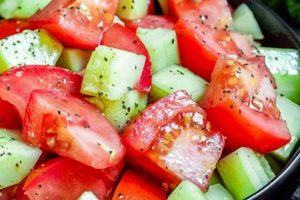
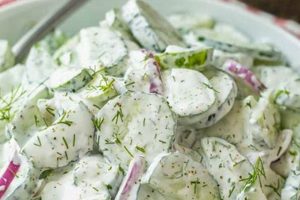
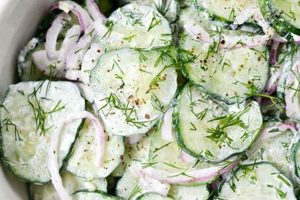
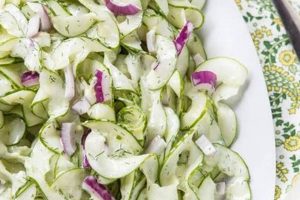
A refreshing and simple dish typically composed of thinly sliced cucumbers and onions, often combined with a light vinaigrette. Variations may include other ingredients like tomatoes, herbs, or feta cheese, offering diverse flavor profiles and textures. A basic version might involve combining equal parts thinly sliced red onion and cucumber, then tossing with a mixture of vinegar, oil, salt, and pepper.
This type of salad provides a cool and hydrating element to a meal, particularly suitable for warmer weather. Its simplicity makes it a versatile side dish, complementing a wide array of cuisines. The inherent low calorie and fat content of the primary ingredients also contribute to its appeal as a healthful option. Historically, cucumbers and onions have been cultivated and consumed for millennia, and their combined use in salads likely has ancient roots in various culinary traditions.
Further exploration will delve into specific variations, offering detailed instructions and ingredient lists. Nutritional information and tips for ingredient selection and preparation techniques will also be covered. Finally, the article will discuss creative adaptations and serving suggestions to enhance culinary experiences.
Tips for a Perfect Cucumber and Onion Salad
Achieving optimal flavor and texture requires attention to detail throughout the preparation process. The following tips offer guidance for creating a truly exceptional salad.
Tip 1: Proper Chilling: Chilling both the cucumbers and onions after slicing reduces pungency and enhances crispness. Thirty minutes in an ice bath is generally sufficient.
Tip 2: Thin and Uniform Slicing: Evenly thin slices ensure a pleasant texture and allow the dressing to coat the vegetables effectively. A mandoline slicer offers optimal precision.
Tip 3: Salt and Rest: Salting the sliced cucumbers and onions draws out excess moisture, preventing a watery salad. Allow them to rest in a colander for 15-20 minutes before rinsing and drying.
Tip 4: Balanced Vinaigrette: The vinaigrette should complement, not overpower, the delicate flavors of the vegetables. A simple combination of vinegar, oil, salt, and pepper is often sufficient. Experiment with different vinegar types for nuanced flavors.
Tip 5: Fresh Herbs: Incorporating fresh herbs elevates the salad’s flavor profile. Dill, mint, parsley, and chives are excellent choices. Add herbs just before serving to maintain their vibrancy.
Tip 6: Timing is Key: To prevent the salad from becoming soggy, dress it immediately before serving. This ensures the vegetables retain their crispness.
Tip 7: Consider Garnishes: A simple garnish can enhance visual appeal and add a touch of elegance. Feta cheese crumbles, toasted sesame seeds, or a sprinkle of paprika offer appealing options.
By following these tips, one can consistently create a flavorful and refreshing cucumber and onion salad that complements any meal. Attention to detail, from ingredient selection to final presentation, ensures optimal results.
The following section offers several variations on this classic dish, incorporating additional ingredients and diverse flavor profiles.
1. Fresh Ingredients

The success of an onion and cucumber salad hinges on the quality of its ingredients. Fresh produce provides optimal flavor, texture, and overall enjoyment. Subpar or aging ingredients can negatively impact the final product, resulting in a less satisfying culinary experience.
- Cucumbers:
Firm, unblemished cucumbers with vibrant skin indicate freshness. Avoid those with soft spots or wrinkled skin. Different cucumber varieties offer varying levels of sweetness and water content. English cucumbers, known for their thin skin and minimal seeds, are a popular choice.
- Onions:
Select firm onions with dry, papery skins. Avoid those with sprouting shoots or soft spots. Red onions offer a milder flavor and vibrant color, while white or yellow onions provide a more pungent taste. Sweet onions, like Vidalia or Walla Walla, can also be used for a sweeter profile.
- Herbs:
Fresh herbs elevate the salad’s flavor profile. Choose vibrant, fragrant herbs like dill, mint, parsley, or chives. Avoid wilted or discolored herbs. Proper storage, such as wrapping herbs in a damp paper towel and refrigerating, extends their lifespan.
- Vinaigrette Ingredients:
High-quality vinegar and oil form the base of the vinaigrette. Extra virgin olive oil offers a robust flavor, while lighter oils like grapeseed or avocado oil provide a more neutral taste. Various vinegars, such as red wine vinegar, apple cider vinegar, or white wine vinegar, contribute distinct flavor nuances. Freshly squeezed lemon or lime juice can also be incorporated.
Utilizing peak-season produce maximizes flavor and nutritional value. Farmers’ markets often provide access to locally sourced, freshly harvested ingredients, further enhancing the salad’s quality. The careful selection of each component contributes to a vibrant and refreshing final dish, showcasing the simple elegance of fresh ingredients.
2. Thin Slicing
Thin slicing plays a crucial role in optimizing both the textural and flavor profiles of cucumber and onion salads. Increased surface area, achieved through thin slicing, allows for greater interaction between the vegetables and the vinaigrette. This maximizes flavor absorption and ensures even distribution of the dressing, preventing pockets of intense flavor or blandness. Additionally, thin slices offer a delicate, pleasant texture, contrasting with the potential fibrousness of thicker cuts. Consider the difference between biting into a paper-thin slice of red onion versus a thick chunk; the former provides a subtle sharpness, while the latter can deliver an overpowering, pungent bite. This principle applies equally to cucumbers, where thin slices contribute to a refreshing crispness, avoiding a dense or watery mouthfeel.
Beyond flavor and texture, thin slicing also influences the salad’s visual appeal. Uniform, delicate slices create an aesthetically pleasing presentation, enhancing the overall dining experience. This uniformity contributes to a sense of refinement and care in preparation. Imagine a salad composed of uneven, thick chunks of cucumber and onion; the visual disparity detracts from the dish’s overall appeal. Conversely, consistently thin slices convey a sense of culinary precision, elevating the perceived quality of the salad.
Mastering thin slicing requires appropriate tools and techniques. While a sharp knife can achieve satisfactory results with practice, a mandoline slicer offers superior precision and efficiency, especially for larger quantities. Consistent thinness ensures even marinating and optimal texture throughout the salad. Challenges may arise with particularly watery vegetables. Salting and draining sliced cucumbers prior to dressing helps mitigate excess moisture, preserving the desired crispness and preventing a diluted vinaigrette. In conclusion, thin slicing represents a fundamental technique in cucumber and onion salad preparation, impacting flavor, texture, and visual presentation. Attention to this detail elevates the final dish from a simple combination of ingredients to a carefully composed culinary experience.
3. Balanced Vinaigrette

A balanced vinaigrette is paramount in an onion and cucumber salad recipe. It provides the critical acidic element that complements the vegetables’ mild flavors without overpowering their delicate nature. The vinaigrette acts as a unifying element, binding the individual components into a cohesive and flavorful whole. A poorly constructed vinaigrette, whether too acidic, too oily, or lacking in seasoning, can compromise the entire dish.
- Acidity:
The acid component provides brightness and complexity. Vinegar choices range from sharp white wine vinegar to mellow apple cider vinegar, each contributing unique nuances. Lemon or lime juice offer a citrusy alternative. The acidity level should be carefully calibrated to enhance, not dominate, the cucumbers and onions. Too much acidity can render the salad unpleasantly tart, while too little can result in a bland, underwhelming flavor profile.
- Oil:
Oil contributes richness and mouthfeel, balancing the vinaigrette’s acidity. Extra virgin olive oil offers a robust flavor, while neutral oils like grapeseed or avocado oil allow the other ingredients to shine. The oil-to-acid ratio impacts both flavor and texture. A higher oil content creates a richer, more emulsified dressing, while a higher acid content produces a lighter, more tart result. The chosen ratio should complement the specific ingredients and desired flavor profile.
- Seasoning:
Proper seasoning is essential for a well-rounded vinaigrette. Salt enhances the flavors of both the vegetables and the dressing itself, while freshly ground black pepper adds a subtle complexity. Other seasonings, such as herbs, spices, or a touch of sweetness, can further elevate the vinaigrette. The key is to achieve a harmonious balance, where no single element dominates. Over-salting can mask the delicate flavors of the vegetables, while insufficient seasoning can result in a flat, uninteresting taste.
- Emulsification:
Emulsification, the process of combining oil and vinegar into a stable mixture, is crucial for a smooth, evenly distributed vinaigrette. A properly emulsified vinaigrette clings to the vegetables, ensuring consistent flavor in every bite. Whisking or blending the ingredients vigorously creates a temporary emulsion, while adding an emulsifying agent, such as Dijon mustard or honey, promotes a more stable, long-lasting emulsion. A poorly emulsified vinaigrette separates quickly, leading to uneven flavor distribution and a less appealing texture.
The delicate nature of cucumbers and onions necessitates a thoughtfully balanced vinaigrette. Each elementacidity, oil, seasoning, and emulsificationplays a crucial role in creating a dressing that enhances, rather than overwhelms, the salad’s inherent flavors. Achieving this harmony results in a refreshing and flavorful dish that showcases the simplicity and elegance of fresh ingredients.
4. Proper Chilling
Proper chilling is integral to a successful onion and cucumber salad recipe, significantly impacting both flavor and texture. Chilling reduces the pungency of raw onions, mellowing their sharp bite and creating a more palatable flavor profile. Simultaneously, chilling enhances the cucumbers’ crispness, offering a refreshing textural contrast to the softened onions. The temperature reduction slows down enzymatic activity within the vegetables, preserving their structural integrity and preventing premature softening or wilting. Consider the difference between a salad prepared with room-temperature ingredients versus one with chilled components. The former may exhibit a harsh onion flavor and potentially limp cucumbers, while the latter offers a balanced, refreshing experience.
The practical application of proper chilling involves refrigerating sliced cucumbers and onions for at least 30 minutes prior to assembling the salad. An ice bath further accelerates the chilling process, maximizing crispness and minimizing pungency. This pre-chilling step is particularly crucial in warmer climates or during summer months, where room temperatures can quickly compromise the salad’s freshness. Furthermore, chilling the prepared vinaigrette separately enhances its emulsified stability and contributes to the overall cooling effect upon serving. Neglecting this step can result in a salad that becomes watery and loses its desired textural contrast as it sits at room temperature.
In summary, proper chilling is not merely a suggestion but a fundamental step in achieving a high-quality onion and cucumber salad. Its impact on flavor, mitigating onion pungency, and texture, maximizing cucumber crispness, is undeniable. Integrating this practice ensures a refreshing and flavorful culinary experience, showcasing the best qualities of these simple ingredients. The practical application, requiring minimal effort, yields significant returns in terms of overall salad quality and enjoyment.
5. Seasoning Adjustment
Seasoning adjustment is essential for a well-balanced onion and cucumber salad recipe. The inherent mildness of cucumbers and the potential sharpness of onions necessitate careful calibration of salt, pepper, and other seasonings. The goal is to enhance the natural flavors of the vegetables, not mask them. The vinaigrette’s acidity also plays a role, influencing the perceived saltiness. A more acidic vinaigrette may require less added salt, while a milder one might benefit from a touch more. Consider a scenario where the vinaigrette incorporates lemon juice; its inherent tartness interacts with the salt, potentially creating an overly salty final product if not carefully adjusted.
Real-life examples illustrate the practical significance. Imagine a salad dressed with a vinaigrette containing a substantial amount of salt. The cucumbers and onions, having absorbed the excess salt, lose their delicate flavors, becoming merely salty vehicles for the dressing. Conversely, insufficient seasoning results in a bland, underwhelming dish, failing to highlight the vegetables’ inherent freshness. Achieving the optimal balance requires continuous tasting and adjustment throughout the preparation process. Factors such as the variety of onion (sweeter varieties might require less salt), the type of vinegar used (more acidic vinegars might require less salt), and personal preference all contribute to the final seasoning decisions. One might consider a scenario using a sweet Vidalia onion; its inherent sweetness balances the acidity and saltiness, potentially requiring less added salt compared to a sharper red onion.
Mastering seasoning adjustment elevates the onion and cucumber salad from a simple side dish to a carefully composed culinary creation. It demonstrates an understanding of flavor dynamics and a commitment to achieving a harmonious balance. Challenges arise when pre-made dressings are used, often containing fixed seasoning levels that limit adaptability. Therefore, preparing a homemade vinaigrette allows for greater control over the final flavor profile, enabling precise seasoning adjustments tailored to specific ingredient combinations and individual preferences. This attention to detail ultimately differentiates a truly exceptional salad from a merely adequate one.
6. Creative Variations

Creative variations elevate the basic onion and cucumber salad recipe from a simple side dish to a versatile culinary canvas. While the core componentscucumbers, onions, and a vinaigretteremain constant, incorporating additional ingredients and flavor profiles expands the dish’s potential, catering to diverse palates and culinary contexts. This adaptability ensures its relevance across a range of cuisines and occasions, from casual picnics to more formal dining experiences. Consider the impact of adding crumbled feta cheese and Kalamata olives; the salad transforms into a Mediterranean-inspired dish. Alternatively, incorporating fresh dill, mint, and a lemon vinaigrette evokes a bright, herbaceous profile. These variations demonstrate the recipe’s inherent flexibility.
Specific examples illustrate the practical application of creative variations. Incorporating sliced tomatoes and bell peppers adds sweetness and textural complexity. A sprinkle of toasted sesame seeds introduces nuttiness and visual appeal. Infusing the vinaigrette with fresh herbs like dill, mint, or parsley adds depth and aromatic complexity. Substituting red wine vinegar for white wine vinegar in the vinaigrette creates a bolder, more robust flavor profile. These examples demonstrate how seemingly minor alterations can significantly impact the final dish, offering a spectrum of flavor experiences without compromising the salad’s core identity. One might consider a scenario where a spicy element is desired; incorporating thinly sliced jalapeos or a pinch of red pepper flakes transforms the salad into a more vibrant, piquant dish.
Understanding the potential for creative variations unlocks the full potential of the onion and cucumber salad recipe. It empowers culinary exploration, encouraging experimentation with flavors and textures. However, challenges arise when variations compromise the salad’s essential balance. Adding overly strong ingredients can mask the delicate flavors of the cucumbers and onions. Therefore, thoughtful consideration of flavor pairings and ingredient proportions is crucial. The ultimate goal remains a harmonious blend of flavors, where each element contributes to the overall composition without overpowering the others. This principle ensures that creative variations enhance, rather than detract from, the inherent refreshing simplicity of the onion and cucumber salad.
Frequently Asked Questions
This section addresses common inquiries regarding cucumber and onion salad preparation, offering practical solutions and clarifying potential misconceptions.
Question 1: How can excess moisture be prevented in the salad?
Salting sliced cucumbers and onions draws out excess water. Allow them to rest in a colander for 15-20 minutes before rinsing and drying thoroughly. This step prevents a watery salad and maintains the vegetables’ crispness.
Question 2: What type of onion is best suited for this salad?
Red onions are generally preferred for their mild flavor and vibrant color. However, white, yellow, or sweet onions like Vidalia can be used for varying flavor profiles. The choice depends on individual preference and the desired level of pungency.
Question 3: Can this salad be prepared in advance?
While the components can be prepared separately in advance, it is recommended to combine and dress the salad immediately before serving. This prevents the vegetables from becoming soggy and maintains their optimal texture.
Question 4: What can be done if the vinaigrette is too acidic?
A touch of sweetness, such as a pinch of sugar or a drizzle of honey, can balance excessive acidity. Alternatively, adding a small amount of additional oil can also mellow the vinaigrette’s sharpness.
Question 5: How long can the salad be stored in the refrigerator?
Ideally, cucumber and onion salad is best consumed fresh. However, leftovers can be stored in an airtight container in the refrigerator for up to two days. Note that the texture may soften slightly over time.
Question 6: What are some suitable garnishes for this salad?
Crumbled feta cheese, toasted sesame seeds, fresh herbs (dill, mint, parsley), or a sprinkle of paprika can enhance both the visual appeal and flavor profile of the salad.
Addressing these common inquiries ensures consistent success in preparing a refreshing and flavorful cucumber and onion salad. Understanding the underlying principles of each step contributes to a consistently positive culinary experience.
The following section provides a complete recipe with detailed instructions and ingredient measurements.
Onion and Cucumber Salad Recipe
This exploration of the onion and cucumber salad recipe has highlighted the essential elements contributing to its success. From the selection of fresh, high-quality ingredients to the precision of thin slicing and the balance of the vinaigrette, each step plays a crucial role in the final outcome. Proper chilling techniques enhance both flavor and texture, while careful seasoning adjustment ensures a harmonious balance. Furthermore, the potential for creative variations extends the recipe’s versatility, offering a range of flavor profiles to suit diverse palates.
The simplicity of this salad belies its culinary potential. Its refreshing nature and adaptability make it a valuable addition to any culinary repertoire. Further experimentation with ingredient combinations and flavor profiles is encouraged, fostering continued appreciation for this classic dish. Ultimately, understanding the underlying principles of preparation empowers consistent creation of a flavorful and refreshing onion and cucumber salad, demonstrating the enduring appeal of simple, fresh ingredients thoughtfully combined.